IN Brief:
- Airbus expects the Eurodrone programme to continue despite uncertainty over French participation.
- The company has removed long-standing risk language around the A400M production programme.
- Both programmes remain important to European defence aerospace manufacturing, supplier continuity, and future mission-system upgrades.
Airbus has signalled confidence in the future of Eurodrone and the A400M military transport programme, easing two sources of uncertainty around major European defence aerospace production.
The company expects Eurodrone to continue even without French participation, following renewed debate over the programme’s role in a defence environment increasingly shaped by lower-cost unmanned systems and high-intensity conflict lessons from Ukraine. Eurodrone remains a multinational medium-altitude, long-endurance uncrewed aircraft programme involving European industrial partners and customer nations.
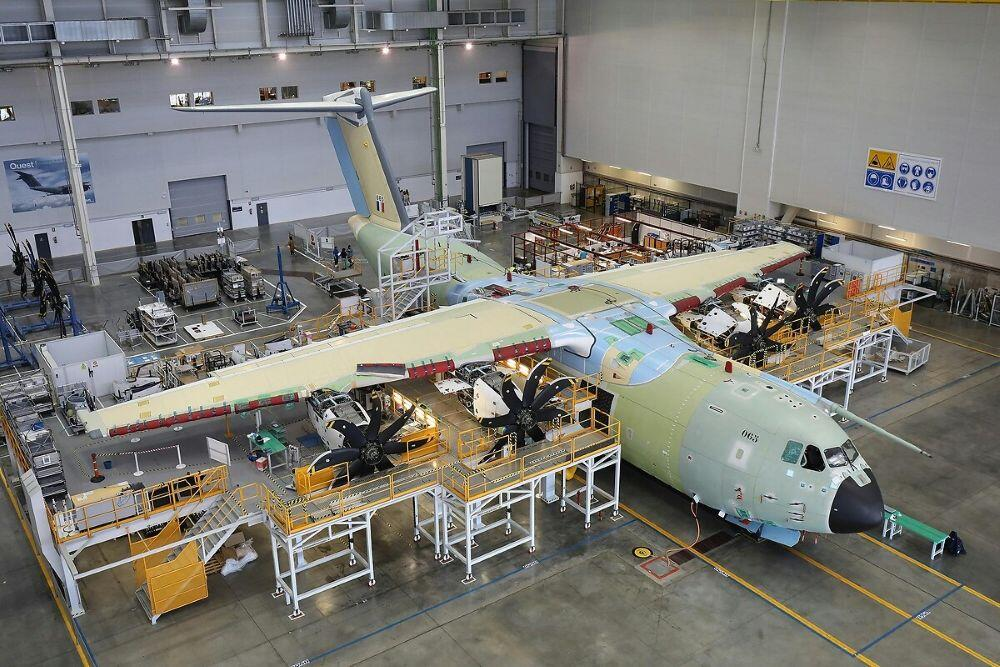
Airbus has also removed long-standing language warning about the future of the A400M production programme. The change points to greater confidence in the military airlifter’s industrial position after years of schedule, cost, export, and capability-development pressure.
The A400M remains central to European air mobility. Airbus continues to develop the aircraft beyond its core transport role, including connectivity upgrades, future broadband communications, tactical data exchange, unmanned systems deployment, electronic combat concepts, firefighting kits, and defensive enhancements such as directed infrared countermeasures for Germany’s fleet.
Production continuity and supplier stability
Eurodrone and A400M production reaches beyond final assembly. Both programmes sustain specialist European capability across aerostructures, propulsion integration, flight controls, mission systems, avionics, ground control equipment, software, certification, and long-term support.
Eurodrone needs sufficient customer certainty to justify production investment, tooling, and supplier readiness. A multinational UAV of this class requires stable requirements, clear software baselines, sensor integration pathways, and agreement on through-life support. Changes in partner demand can unsettle suppliers well before an aircraft reaches full-rate production.
A steadier A400M outlook gives suppliers a more predictable environment for spares, upgrades, and support work. Military transport aircraft rely on long production tails and continuous modification programmes, making continuity essential for specialist labour, certified supply chains, and long-term engineering capacity.
Upgrade work as an industrial engine
The A400M’s next phase will be shaped by mission-system upgrades as much as airframe production. Airbus has outlined potential roles in broadband connectivity, Combat Cloud participation, drone mothership operations, and stand-off jamming. These concepts require power generation, antenna integration, software assurance, electromagnetic compatibility work, data security, and certification across a multinational fleet.
The Block Upgrade 0 agreement with OCCAR already brings improvements to tactical information systems and satellite-based landing capability, while future NATO compliance requirements will create further modification work. Those upgrades create recurring engineering, test, and integration activity across the European aerospace base.
Eurodrone and A400M sit at different points on the same industrial curve. One is working to secure its production future in a contested UAV market; the other is moving from production risk into a broader sustainment and capability-upgrade phase. Both programmes will continue to test Europe’s ability to deliver complex defence aerospace capability at scale.