IN Brief:
- Taiwan’s first domestically built submarine has completed its first torpedo launch verification during sea acceptance testing.
- The test validated combat-system detection, tracking, fire control, launch, guidance, and recovery procedures.
- The milestone strengthens Taiwan’s undersea industrial base as CSBC leads a planned eight-boat submarine programme.
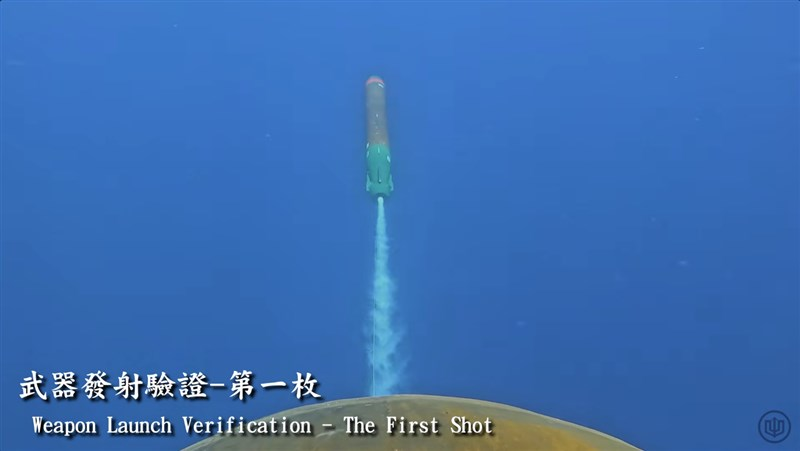
Taiwan’s first domestically built submarine, Narwhal, has completed its first torpedo launch verification, giving the island’s indigenous undersea warfare programme one of its most technically demanding test milestones so far.
The test took place during the eighth round of dive trials for the submarine, also known as Hai Kun. The boat fired two torpedoes during the weapon launch verification phase of its sea acceptance tests, with the exercise designed to authenticate combat-system reconnaissance, analysis, launch, and guidance functions. Support vessels and helicopters assisted the trial, while Taiwan’s Da Wu rescue and salvage ship recovered the munitions after launch.
By moving from platform proving into weapon-system validation, Narwhal has entered a phase where the submarine’s most complex onboard systems are tested as an integrated fighting platform. Surface runs, diving checks, propulsion testing, and basic manoeuvring provide essential data, but they do not prove that a submarine can detect, classify, assign, fire, and guide a weapon through the full engagement chain. Torpedo launch verification brings together the boat, its sensors, fire-control software, launch hardware, crew procedures, and naval test infrastructure in a single sequence.
CSBC Corporation, Taiwan, is leading construction of the planned eight-submarine fleet. The lead boat has already completed underwater trials, and Taiwan wants at least two domestically developed submarines deployed by 2027. The first vessel carries a reported price tag of around T$49.36bn and uses a Lockheed Martin combat system, with US-made Mark 48 heavyweight torpedoes planned for the class.
Submarine production remains one of the most demanding defence manufacturing disciplines, particularly for a country building a national capability for the first time. Pressure-hull fabrication, acoustic control, shock qualification, battery safety, weapon-handling systems, mast integration, combat-management software, sensor alignment, wiring density, and sea-trial correction loops all have to converge inside a platform where space is scarce and tolerance for error is low.
Narwhal’s latest test also gives Taiwan’s industrial base a practical measure of its ability to coordinate foreign-supplied subsystems with domestic shipbuilding, naval test infrastructure, and local engineering capacity. The programme has drawn on expertise and technology from several countries, including the United States and Britain, but final integration rests with Taiwan’s shipyard and naval authorities. Each successful trial strengthens confidence in that model, even though repeat production will be the harder task.
Regional pressure is sharpening the programme’s strategic value. China’s naval expansion has increased Taiwan’s need for survivable maritime denial assets that can complicate amphibious, blockade, and carrier operations. Submarines impose search, escort, and anti-submarine warfare burdens on a larger adversary, and a domestically sustained fleet gives Taiwan more control over upgrades, repair cycles, spares, and operational availability than a force dependent entirely on imported hulls.
The next production challenge is repeatability. First-of-class submarines almost always generate engineering corrections after sea trials, from machinery behaviour and acoustic signatures to software performance, maintainability, and crew workflow. Lessons from Narwhal’s weapon launch phase will need to be captured and applied to follow-on boats without disrupting the schedule or turning each vessel into a bespoke engineering exercise.
That transition demands a deeper supplier ecosystem. Submarine work draws on specialist steel, welding processes, valves, pumps, electrical systems, batteries, sonars, combat-system interfaces, hydraulic systems, weapon-handling equipment, and precision machining. Even where foreign technology is used, domestic yards need the configuration control, documentation discipline, and sustainment planning required to support decades of maintenance and upgrade work.
Taiwan’s progress sits within a wider Asian move towards indigenous naval manufacturing. Pakistan has recently commissioned its first Hangor-class submarine in China, with later boats intended for construction at Karachi Shipyard, a development IN Defence covered in Pakistan commissions first Hangor-class submarine. Singapore is advancing unmanned-systems mothership production through its Victory-class MRCV programme, while South Korea continues to expand submarine, destroyer, and missile production through national yards.
Taiwan faces a more constrained diplomatic and supply-chain environment than most regional naval builders. Export controls, Chinese pressure on suppliers, and the sensitivity of submarine-related technologies place limits on sourcing options. Against that background, Narwhal’s torpedo test offers more than a programme milestone; it gives Taiwan a stronger technical basis for building an undersea enterprise that can move from lead-boat achievement to fleet-level production.