IN Brief:
- Pakistan has commissioned PNS/M Hangor, the first boat in an eight-submarine programme.
- Four submarines are being built in China, with four planned for construction in Pakistan.
- The programme expands Pakistan’s undersea capability while developing local submarine construction and sustainment capacity.
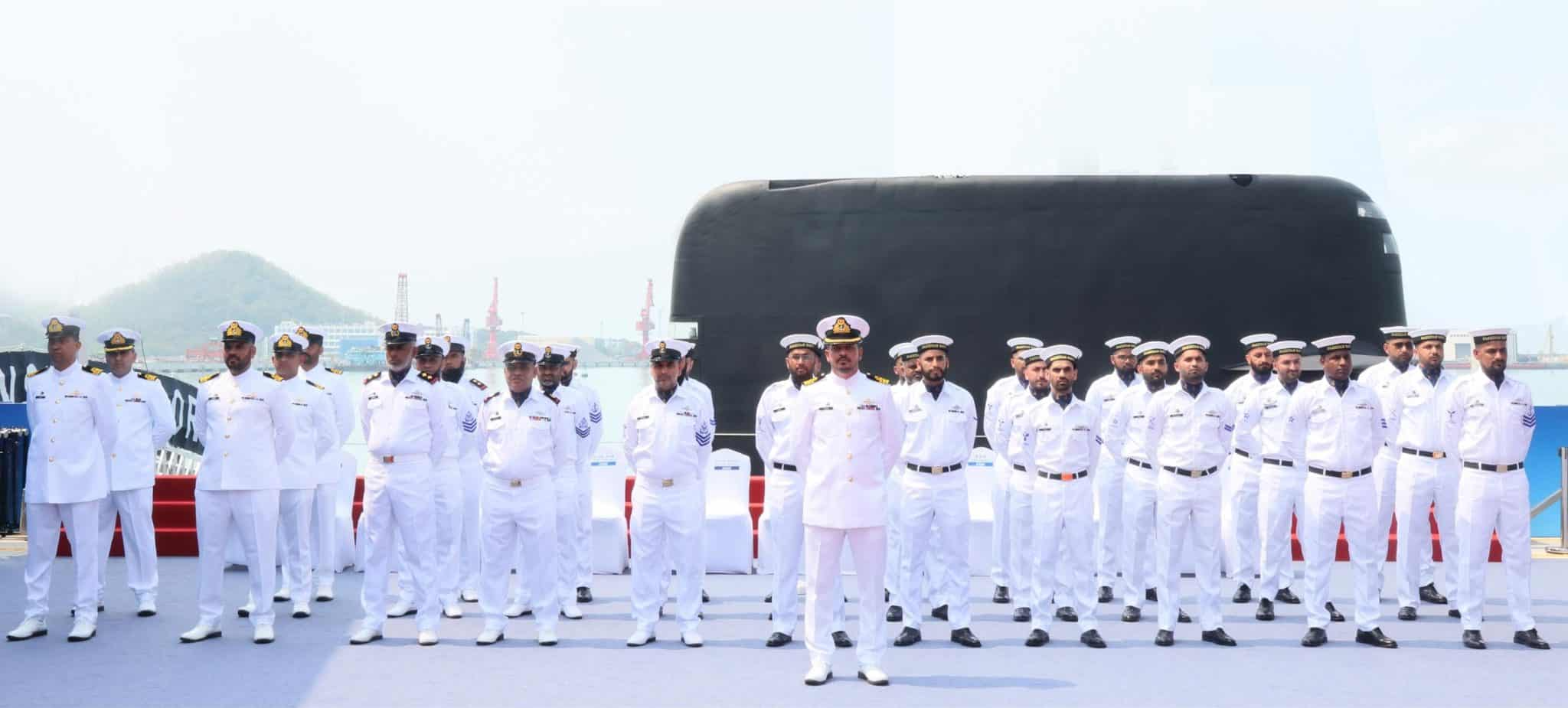
Pakistan has commissioned PNS/M Hangor, the first of eight Hangor-class submarines being delivered under a major China-Pakistan naval programme.
The commissioning ceremony took place in Sanya, China, attended by Pakistan’s President Asif Ali Zardari, Chief of Naval Staff Admiral Naveed Ashraf, and senior Pakistani and Chinese naval officials. The lead boat forms part of Pakistan’s long-running effort to modernise its submarine fleet and strengthen conventional undersea capability in the Arabian Sea and Indian Ocean.
The Hangor class is based on China’s Type 039A/Yuan-class diesel-electric submarine design. The boats are expected to include air-independent propulsion, modern sensors, and weapons suitable for anti-surface, anti-submarine, and special operations support roles.
The programme is structured around eight boats, with four built in China and four planned for construction at Karachi Shipyard & Engineering Works. That split makes the programme a naval industrial project as well as a fleet modernisation effort.
Submarine production and transfer
Submarine construction places unusual pressure on the industrial base. Pressure hull fabrication, weld quality, acoustic control, propulsion integration, combat-system installation, and battery safety all demand controlled production environments and experienced inspection teams.
The Karachi Shipyard element gives Pakistan a route to deepen local competence in submarine assembly, outfitting, and sustainment. Imported systems will still sit at the centre of the programme, but domestic construction can build familiarity with hull sections, cabling, machinery installation, test processes, and dockyard support.
Long service lives make that experience valuable. Submarines require repeated refits, battery work, sensor updates, software changes, and weapons integration across decades. A navy that can retain more of that knowledge locally reduces dependence on overseas yards for every stage of through-life support.
Undersea fleet renewal
Pakistan’s existing submarine fleet includes French-origin Agosta boats, making Hangor a substantial capability shift. Air-independent propulsion should improve submerged endurance compared with older diesel-electric designs, while the larger platform provides more scope for modern sensors, weapons, and mission equipment.
The first commissioning now starts the harder phase of operational integration. Crew training, shore support, spares, weapons certification, and maintenance routines will determine how quickly the class becomes a reliable fleet asset. Pakistan’s naval industrial base will be measured by production discipline and sustainment depth, not only the number of boats delivered.