IN Brief:
- Singapore has started steel cutting for its third and fourth Victory-class Multi-Role Combat Vessels.
- The 8,000-tonne ships will operate unmanned air, surface, and underwater systems from a modular mothership configuration.
- The programme strengthens Singapore’s domestic naval construction base and combat systems integration capacity.
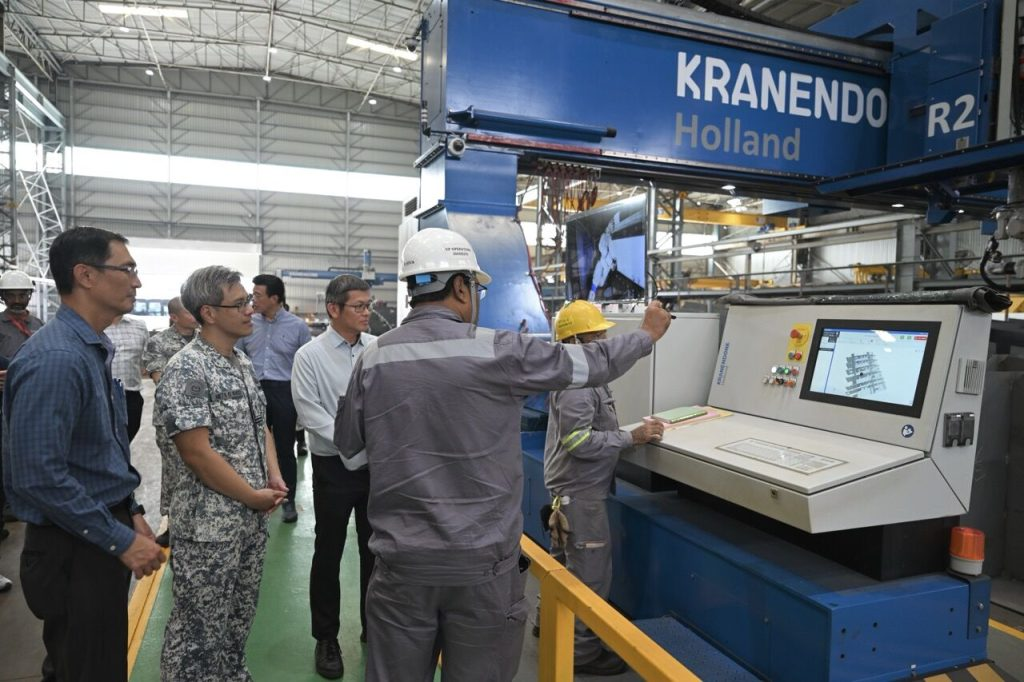
Singapore has started steel cutting for the third and fourth Victory-class Multi-Role Combat Vessels, moving the Republic of Singapore Navy’s next-generation surface combatant programme further into serial production.
The work is taking place at ST Engineering’s Benoi shipyard, where Singapore is building a six-ship class intended to combine surface combatant capability with the command-and-control capacity needed to operate unmanned systems across air, surface, and underwater domains.
The third vessel will be named RSS Vigilance, while the fourth will be named RSS Valiant. The first-of-class, RSS Victory, was launched in October 2025, with the second vessel expected to follow later in 2026.
At around 150 metres in length and 8,000 tonnes displacement, the MRCV is the largest and most complex warship built in Singapore to date. Its core role is to act as a mothership for uncrewed aerial vehicles, uncrewed surface vessels, and autonomous underwater vehicles.
Serial production moves beyond first-of-class learning
The start of parallel steel cutting for vessels three and four moves the programme into a more repeatable production phase. That shift is important for a vessel carrying extensive mission-bay, modular payload, launch-and-recovery, and command-system requirements.
The yard must maintain hull production rhythm while integrating combat systems, unmanned systems support infrastructure, communications, and future payload flexibility. Modular design adds resilience over the ship’s service life, but it also demands tighter control of interfaces, power margins, cooling, access routes, and software architecture during build.
Mothership design reshapes shipyard integration
The MRCV’s mothership role places heavier emphasis on open architecture, payload change-out, and support for systems that may evolve faster than the ship itself. Traditional naval construction can lock much of a ship’s fighting capability into fixed systems; the MRCV model requires more flexible arrangements for sensors, offboard vehicles, data management, and mission packages.
Singapore’s shipbuilding base is now working through the practical demands of that model at production scale. The result is a programme that blends naval construction, robotics support, combat management, and fleet-level autonomy into a single industrial workload.